Sinetik:pure · Onda FG-01

Lock the heel.
Free the toes.

Sinetik:pure started from something seen on the pitch: feet deforming inside boots that were too narrow, chosen for how they looked. A football boot with a wide forefoot and the hold a cutting sport actually demands. Designed in Switzerland, made in Portugal — the European anatomical boot.

01

The problem nobody looks at

You've gone half a size down "to feel the ball better." You know the black toenail in November, the blister on the little toe, the burn under the forefoot after a match on dry ground. On a pitch, these things have become normal. They shouldn't be.

The foot is not just a platform. It is an organ of perception: thousands of receptors constantly feed balance, loading and coordination. Locked inside a narrow, heavily wrapped boot, it sends back impoverished information. Footwear that is too short or too tight is also associated in the literature with subungual haematoma, toe deformities and Morton's neuroma.

In a growing player this matters: the shape of the adult foot is built between roughly 10 and 18, inside the boot worn five times a week.

And that narrowness has no technical justification. It comes from aesthetic legacy and speed marketing — not from biomechanical optimisation.

82%
of female players report high discomfort in their boots.
Prempeh & Pennington, 2025

The same size. Not the same room.

The same foot, in two different volumes. On the left, the geometry the market settled on. On the right, the one we drew.

Conventional boot

Pressure concentrates on a few points.
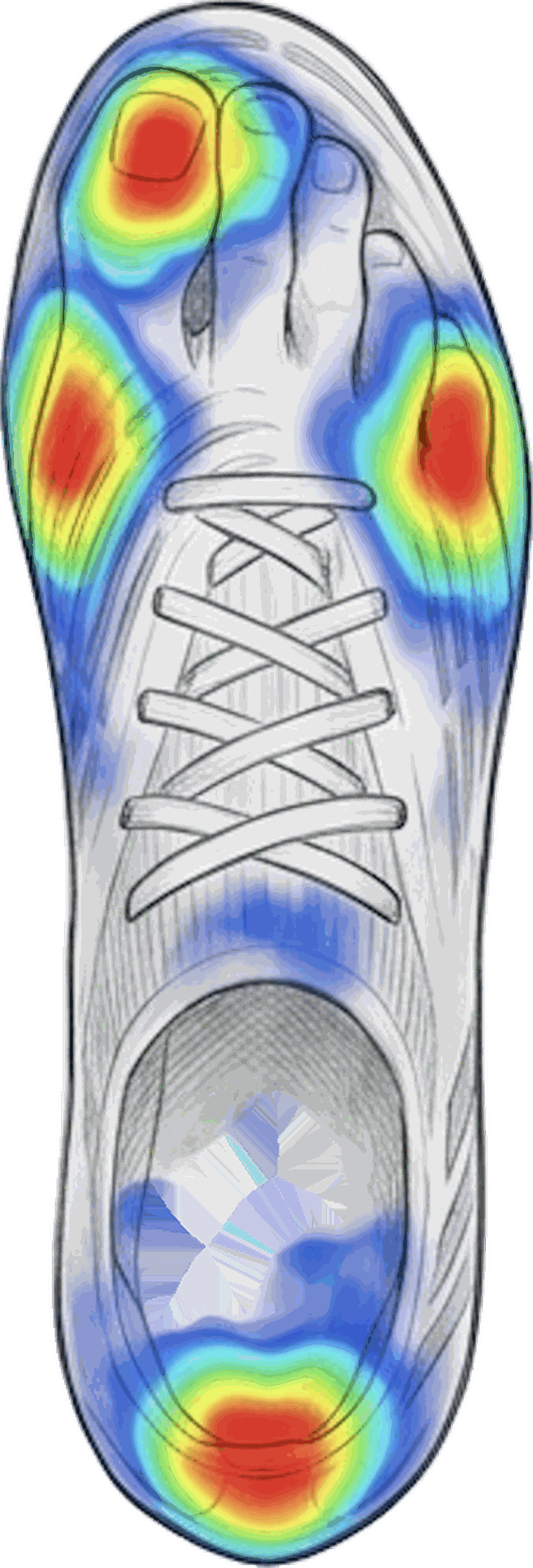
Pressure map of a conventional boot: red hotspots on the big toe, both metatarsal heads and the heel

The red hotspots are where the forefoot presses against the upper: the big toe, both metatarsal heads, the edge of the little toe. Those are what produce the black toenail and the end-of-season blister.

Onda FG-01

Pressure spreads across the whole surface.
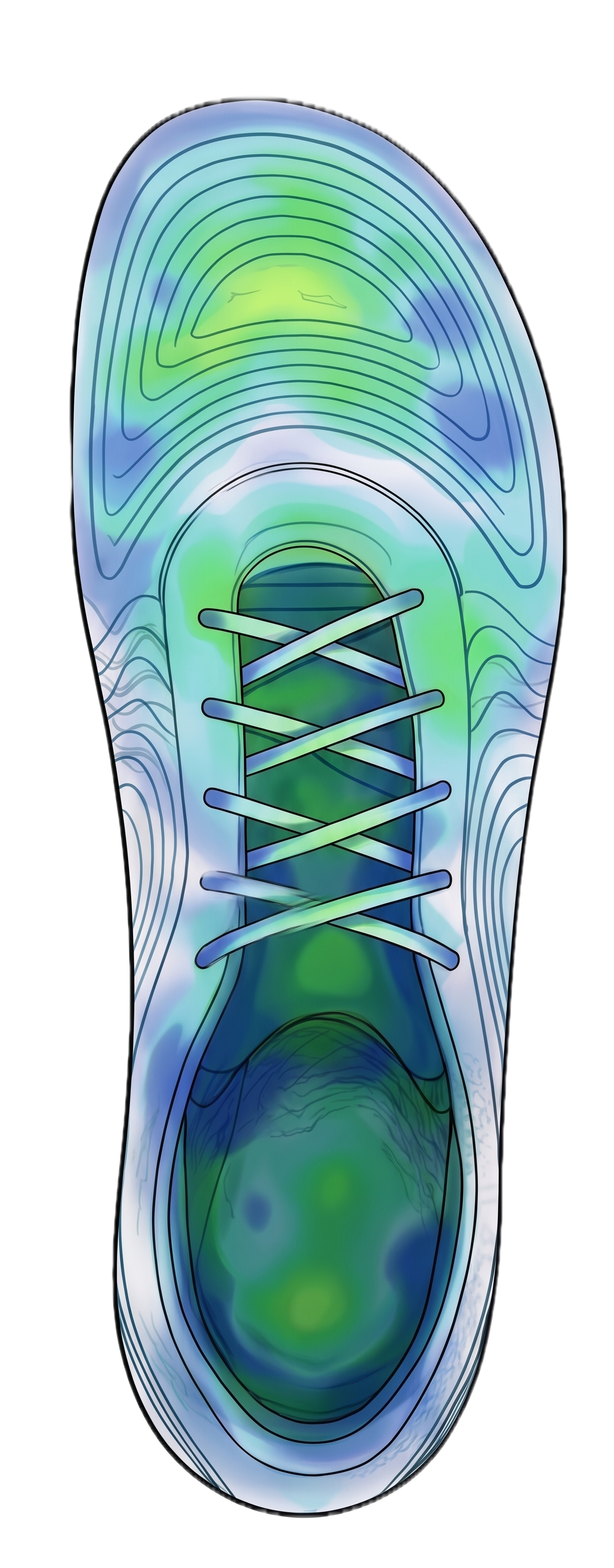
Pressure map of the Onda FG-01: load spread across the whole forefoot, with no hotspot

No hotspots left. The wide forefoot lets the toes spread, the load distributes across the whole contact surface — and the heel stays locked, because that is where hold is won, not at the front.

Increasing pressure Illustrative maps, produced from our design testing
02

Our design principles

Six decisions, and the reason behind each. No technology invented for the story.

01

A wide forefoot

The shape follows real anatomy: the toes keep the room to spread as the foot loads, the way they do barefoot.

02

A locked heel

This is where hold is won — structured counter, central lacing. The foot doesn't float over the studs. Wide at the front does not mean loose.

03

A plate that works

Pebax from the first model, stiffness tuned by zone: firm enough to transmit energy, flexible enough for a natural roll.

04

Studs that let you turn

A conical-dominant stud map, designed to let the foot pivot rather than lock into the ground. Firm ground, natural grass.

05

Minimal stack

No thick midsole. Comfort comes from shape, footbed and flex — not from a stack of foam that cuts you off from the ground.

06

An honest lifespan

A boot that lasts two seasons beats a recycled boot that lasts six months. Removable, replaceable footbed, compatible with your orthotics.

03

What we don't promise you.

Plenty of brands will swear their boot makes you play better. We won't.

There is no solid evidence that a wide forefoot improves ball touch. We could have sold you that anyway. We won't. And no boot prevents injury — the ones that claim otherwise are lying to you.

What we stand behind is what the literature actually supports: a foot that keeps its function, a geometry that respects your anatomy, and comfort that lets you play without thinking about your feet.

The rest — the speed, the touch, the goals — is still your job.

Animated render
360° view

Design renders. The final model will be very close to these; physical prototypes have not been photographed yet.

04 · Firm ground · First model

Onda FG-01

A boot for training and for matches, for the demanding amateur or professional adult as much as the developing player. Developed with partners in northern Portugal, in Europe's historic footwear cluster.

CHF259 Indicative price
In development. Prototypes are tested on the pitch before anything goes on sale — we'd rather ship late than approximate. The boot is not for sale yet. Leave your email and your size and you'll be the first to know when reservations open.
Size (EU) — tell us yours, the grading is being decided now
3839404142 43444546
SurfaceFirm ground (FG) — natural grass
ShapeAnatomical, wide forefoot
PlatePebax, zoned stiffness
FootbedRemovable, orthotic-friendly
Made inNorthern Portugal
SizesEU 38 to 46 (final grading confirmed before production)
05

You'll know where your boots come from

No anonymous factory on the other side of the world. The Onda is developed and assembled in northern Portugal, in the historic footwear cluster, with a footwear technology centre as validation partner and a plate sourced in Europe.

Materials are chosen for durability first: a boot that lasts two seasons beats a recycled boot that lasts six months. We don't use "green" as a slogan — we show you the chain, step by step.

Development and assembly: northern Portugal · Plate: Europe · Certifications are listed only for components that actually carry them.

Doing for football what minimalism did for running: reconciling the foot and performance.